
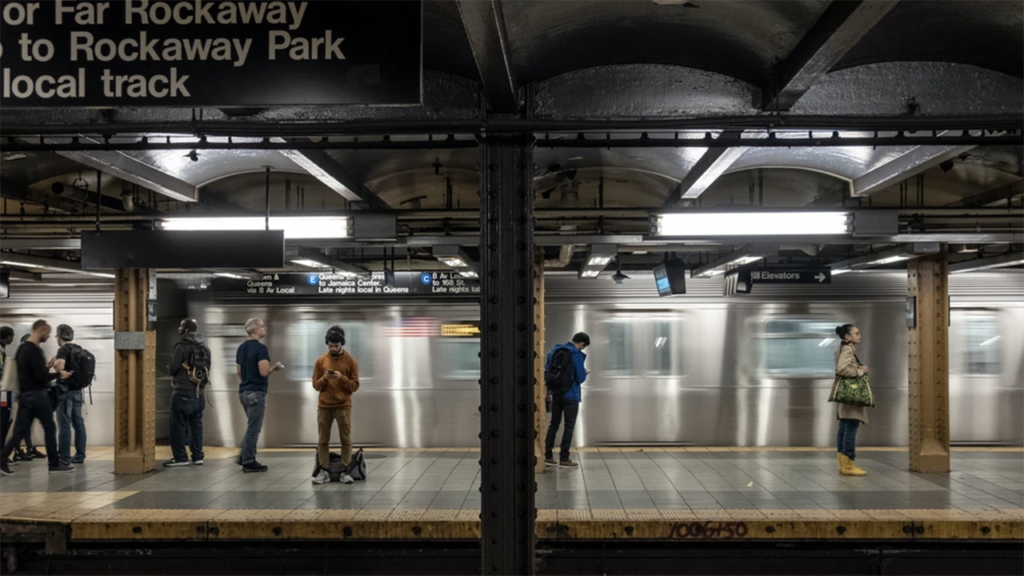
The New York Metropolitan Transportation Authority (MTA) on March 19 reported seeking proposals from railcar manufacturers for what it described as its “largest subway car contract in history” with a base order of 1,140 cars to replace the R62 and R62A fleets operating on New York City Transit’s (NYCT) 1, 3, 6 lines, and if an option to purchase the additional 1,250 cars is exercised, to replace the R142 and R142A cars on the 2, 4, 5 lines. In total, the contract includes 2,390 model R262 cars for the “A” (numbered) Division, which MTA said was more cars than the Chicago Transit Authority and Massachusetts Bay Transit Authority subway fleets combined. Proposals are due Sept. 8, 2026, and a contract is expected to be awarded by early 2028.
The contract will be funded by MTA’s $68 billion 2025-29 Capital Plan. The purchase also includes funds made available through the 2020-2024 Capital Plan, which is supported by congestion pricing revenues, according to MTA.
The transit agency said its RFP (Request for Proposals) outlines that the future order will contain a “to be determined” number of open gangway cars, which would be a first on the A Division. It also outlines “technical specifications that are designed to enhance efficiency, security, performance, and the customer experience.” These include “higher quality announcement systems, assistive listening devices that allow hearing-impaired passengers to connect to personal devices, like hearing aids.” Efficiency upgrades, it noted, include installation of automatic passenger counting (APC) system and electric braking control to achieve savings through fewer parts. Security specifications include onboard cameras like those currently installed on the existing subway fleet and onboard platform edge CCTV, along with an electronic lock to prevent unauthorized cab access.
With a new Rolling Stock Program in place—announced in February and led by MTA veteran Jessie Lazarus to manage the purchase of all new subway, bus, and commuter railcars, including the $12 billion investment from the 2025-29 Capital Plan to replace the MTA’s aging fleets—the MTA said it “has approached this contract differently, modernizing the terms and conditions and encouraging innovation by giving manufacturers greater flexibility to propose new ideas.” The agency noted that more than 60% of the technical specifications are also now “performance-based, rather than design-driven,” and for the first time, the terms request proposers to submit “total cost of ownership projections.” These efforts, it said, “result in a streamlined contract that adopts a balanced approach between the current challenges that contractors face and ensuring that the Authority retains the necessary tools at its disposal to ensure the timely delivery of quality cars that riders deserve.”
This “historic” car contract could replace up to 36.4% of the subway’s entire fleet—17.3% percent with just the base order alone, MTA said. The subway’s entire fleet comprises 6,574 cars. “The new cars will significantly improve reliability with a higher mean distance between failure,” MTA reported. “The R262 has an MDBF requirement of 200,000 miles, compared to the R62/R62A’s average of 89,000 miles. This upgrade will reduce the number of problems customers experience en route and decrease the amount of time cars are taken out of service.”
“Thanks to [New York] Governor [Kathy] Hochul, the MTA has a historic $68 billion 2025-2029 Capital Plan, and New Yorkers are seeing a Golden Age of transit investment,” MTA Chair and CEO Janno Lieber said during the announcement (watch video below). “So much of our capital investment goes unseen, but this next subway car order—our largest ever—is a major step to visibly delivering the modern transit system New Yorkers deserve.”
MTA Chief, Rolling Stock Program Jessie Lazarus said: “This will be the largest order of new subway cars in MTA history, and we’re modernizing our approach to attract as many qualified firms as possible. We’re asking the industry to come with their best ideas—technical and commercial—to meet our performance standards and help the MTA deliver the world class transit experience our customers deserve.”
“We’re talking about replacing cars that have been around since the 1980s—is anyone else driving 40 year-old-cars?” NYCT President Demetrius Crichlow commented. “Even though we’ve managed to achieve historic on-time performance while adding service with this fleet, it’s time to enter the modern era. And our first of its kind Railcar Acceptance and Testing Facility [launched in November near the South Brooklyn Marine Terminal in Sunset Park] serves as a symbol to New Yorkers that we’re serious about delivering on the promise of this historic procurement.”
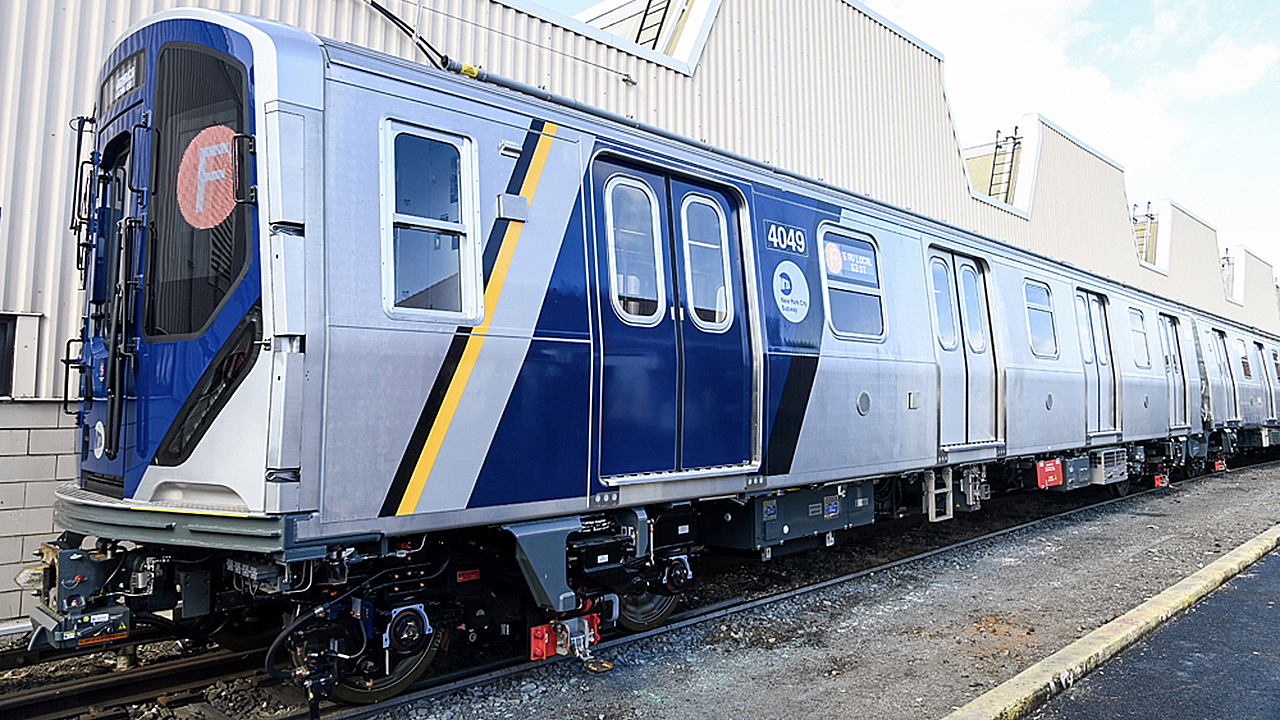
Separately, in October the MTA Board approved the $1.507 billion order for 378 new Kawasaki Rail Car, Inc.-built R268 rapid transit cars for NYCT. The cars will run on the B (lettered) Division and begin arriving in fall 2028. This contract builds on the successful procurement of R211 cars.
In January 2018, MTA awarded a contract to Kawasaki to design, build, and deliver 535 rapid transit cars, comprising 440 R211A (traditional closed-end) and 20 R211T (open gangway) cars for NYCT, and 75 R211S cars for Staten Island Railway (SIR). The contract included two options: Option 1 for 640 cars, and Option 2, for 333-437 cars. In October 2022, the agency exercised Option 1 for 640 R211s for $1.78 billion. MTA in December 2024 exercised Option 2 for 435 additional R211s—355 R211A/S cars and 80 R211T cars. That option, valued at $1.27 billion, brought the total number of R211s ordered to 1,610. As of late 2025, 750 of the R211s had been delivered; another 860 were still to arrive. MTA began phasing into service the first two R211T trainsets in 2024. R211s are now running on the A, B, C and G lines, and there are plans to add them on the D and the Rockaway Park S within the next two years, according to MTA. All the cars for SIR are in operation.
Separately, MTA in June 2025 announced that its Finance Committee approved the purchase of 316 Alstom Transportation-built M-9As. This included 160 cars for Long Island Rail Road and 156 for Metro-North Railroad.


