
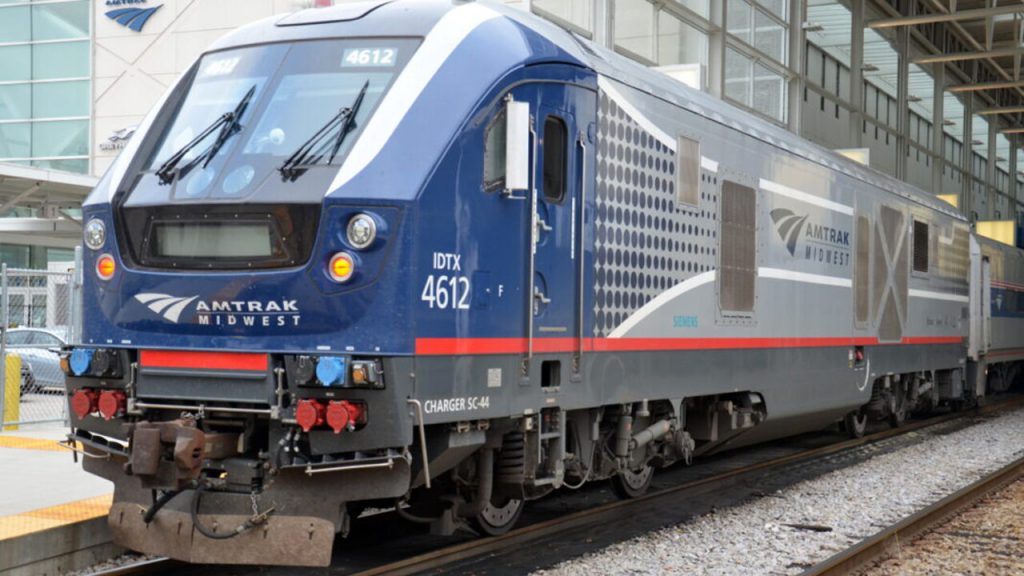
Amtrak is now repairing the East River Tunnels between New York Penn Station and Queens, as we have been reporting. That project has brought service reductions, including on the Empire Service trains in New York State, some of which go as far as Montreal, Toronto, or Chicago. Most Empire Service trains originate or terminate at Rensselaer Station near Albany, and Amtrak has eliminated some of those runs to accommodate the tunnel project.
We recently reported that New York Gov. Kathy Hochul had planned to use Metro-North, a railroad owned by the State, to help fill the gap by running one daily round trip between Rensselaer and Manhattan’s Grand Central Terminal, the first scheduled trains to run between those endpoints since 1991. The northern terminus for Metro-North’s Hudson Line trains is Poughkeepsie, half-way between New York City and the Albany area. The proposed Metro-North trains would also stop at Rhinecliff and Hudson, similarly to the Amtrak trains, and they were slated to start running in March. More recently, as we also reported, Amtrak now plans to restore the previous and more-robust schedule and Hochul backed off from the Metro-North plan. Was it a coincidence that Amtrak suddenly planned to restore its previous schedule during that month? Was it also coincidental that Hochul backed off from the plan to add a Metro-North round trip from GCT instead?
Demand, Capacity, Fares
Metro-North is a component of the Metropolitan Transportation Authority (MTA). On Feb. 2, MTA Chair and CEO Janno Lieber appeared on Capitol Pressroom, a current affairs program produced by WCNY, the NPR station in Syracuse. Regarding the proposed, but now shelved, plan for Metro-North to run Rensselaer (Albany) service, he said: “Even though Amtrak has now backed out of the agreement for MTA to run a train or two to Albany on a regular basis, we’re interested in continuing to explore that and, as the governor said, we got a lot of positive response from people because they’re interested in the idea of a train that suddenly doesn’t cost a hundred bucks, or even more, on a holiday or summer weekend. They’re interested in more-affordable options,” He described the exchange between Hochul and Amtrak, and said that Amtrak had agreed to Metro-North running some trains. Regarding Amtrak, he added: “Once they saw how enthusiastic people were about Metro-North, it seemed like they feared the competition and they backed away, and the governor got what she wanted, which is the restoration of full service, but she also heard clearly that people are interested in having us come north of Poughkeepsie, and we’re going to explore it.” Lieber also acknowledged that Metro-North would need the approval of Amtrak and CSX, which owns the line, to operate the service.
Lieber raised the issues of capacity and fares. Regarding the former, he said that a Metro-North train could hold two or three times as many passengers as an Amtrak train. Today, most trains on the Empire route, including the Toronto and Montreal trains, run with five cars, which limits capacity. The New York section of the Lake Shore Limited to and from Chicago is slightly longer. Still, reducing daily frequencies results not only in less convenience for riders, but also in less overall capacity.
According the Law of Supply and Demand, reducing capacity results in higher fares. Amtrak fares vary according to airline-style “fare bucket” calculations, which raise fares as riders reserve seats and trains fill up. At this writing, fares between those stations on Monday, February 9 range from $44 to $79, while fares for Sunday, March 8 range from $38 (the lowest fare) to $68. In a strange anomaly, the Rensselaer fare on the Toronto-bound Maple Leaf (Train 63) is $38, while the fare on the Montral-bound Adirondack is $59, even though the trains now run combined as far as there. The same evening, southbound passengers on Train 64 from Toronto are charged $51, while riders on the Montreal section of the combined train (Train 68) are charged $68, the only train charging such a high fare that day.
Seniors and persons with disabilities receive a discount on Amtrak, but only 10% (it used to be 15%).
In contrast, Metro-North had planned to charge a flat fare of $40 between Grand Central Terminal (on Manhattan’s East Side, where other Metro-North trains originate or terminate) and Rensselaer. That is only $2.00 more than Amtrak’s lowest fare, and Amtrak fares during busy times have run as high as $108 (which this writer saw, but they could have been higher). Amtrak agreed to cap its fare at $99, but few fares exceeded that amount, so Amtrak did not lose much by offering that apparent concession.
One benefit that some riders going south or west of the Capital District will get when the previous schedule returns is a shorter wait at Rensselaer, but still a relatively long one while the two sections are split or joined. Passengers going toward Toronto have a standing time of only 20 minutes (reasonable for the station work), but those going toward Montreal must wait for one hour and 55 minutes, only five minutes short of two full hours! From Toronto, the scheduled standing time is one hour and 35 minutes, while it’s 40 minutes for riders coming from Montreal, as of now. There isn’t much to do near the Rensselaer station, although there is food available (at Jean’s restaurant in a former firehouse when it’s open, or two long blocks away at Stewart’s Shops, a convenience store with locations in Upstate New York and Vermont that sells good hot dogs, chili, and ice cream). There is not much else nearby. We don’t know why Amtrak did not make a deal with the host railroads to reschedule Trains 64 and 69 to reduce the standing time, an undesirable feature of the trip that probably discourages potential riders.
We can conjecture all we want as we ponder recent events surrounding the Hudson River portion of the Empire route, but there is another question to consider: In backing away from the Metro-North run, did the governor take the easy way out at the expense of the riders? Going beyond New York State, did she miss an opportunity to establish a precedent that would have raised a policy issue that could become more important as the next several years (and maybe more) go by? While the Northeast Corridor (NEC) is unique on the American rail scene, there are other corridors scattered throughout the country. Many of them are run by Amtrak, but some could be operated by regional “transit railroads” affiliated with local transit providers. Some of these railroads are already running corridor-length lines, as well.
When Amtrak eliminated the northern portion of the Silver Star Florida train along the NEC and combined it with the Capitol Limited in November 2024, one of its rationales was that increased crowding in New York City that necessitated cutting the number of moves between Sunnyside Yard and Penn Station also required truncating the Star. With the return to the former schedule for the Empire trains later this month, that should count as an acknowledgment by Amtrak that there will be enough capacity to run the schedule that ran through Nov. 9, 2024. In that event, Amtrak will be able to run some through coaches and sleeping cars between New York and Florida with switching at Washington D.C., even if the through-running section between Chicago and Miami though Pittsburgh keeps. Running that way. In essence, if Amtrak refuses to restore the convenience the riders north of the nation’s capital enjoyed on the old Silver Star, it would constitute an admission by Amtrak that making more Superliner cars available by eliminating the Capitol Limited was the sole relevant reason for the change, and that both trains can be operated with Amfleet II equipment.
Rings Around the City
Corridor-length routes are the mainstays of rail travel in many places, and they account for most of the trains that Amtrak runs outside the NEC today. There are only 13 long-distance routes that are open to non-motorists and motorists alike (the Auto Train does not welcome “foot passengers”), so most of Amtrak’s non-NEC trains run on corridor-length routes, that offer several daily frequencies. Some of them take more than three hours end to end, like the Cascades service in the northwest and the corridors in Illinois, while others take less time. The shortest is the Hiawatha route between Chicago and Milwaukee, with a 90-minute running time. Others take three hours or less and operate where there is a regional “transit railroad” in the area that could run the trains as an alternative to Amtrak. There is some competition between Amtrak and the transit railroads along the NEC. For example, between New York and Philadelphia, riders have the choice between a faster ride at a higher fare on Amtrak or a longer ride and a lower fare using NJ Transit and SEPTA, with a change of trains and a wait at Trenton.
For this article, i’ll focus on corridors in other places. There are several Amtrak-run corridors that could be operated by transit railroads instead. Metro-North could run between New York and Rensselaer, as discussed previously. The running time on the Keystone Corridor between Philadelphia and Harrisburg is about 1:45. Instead of Amtrak, SEPTA could run it, and such an operation was proposed in the past. Metra, Chicagoland’s regional railroad, is talking about running a corridor-type operation to Rockford and could also run the Milwaukee service under an agreement with Wisconsin. It could also extend its trains that go as far as Kenosha to Racine and Milwaukee, another long-standing proposal that has gotten nowhere so far, but remains feasible. The Downeaster trains between Boston and Brunswick, through Portland, are operated by Amtrak under contract with the Northern New England Passenger Rail Authority (NNEPRA). As an alternative, NNEPRA could choose the MBTA (the “T”) in Boston to run the service, as long as the T can add a food service car to the consist. Since the agency does that for the Cape Flyer, which runs between Boston and Hyannis on summer weekends, the Downeaster service could change into a larger scale, but similar, operation on the T.
A model of that sort could work elsewhere, too. Amtrak’s Pacific Surfliner corridor runs for about three hours south of Los Angeles on the historic Sante Fe Surf Line (now BNSF) to San Diego and about three hours north of the city on the historic Southern Pacific line (now UP) to Santa Barbara. Regional railroad Metrolink could run the Santa Barbara service, while Metrolink and the North County Transit District, which operates Coaster trains between Oceanside and San Diego, could run that route jointly. The Capitol Corridor runs between San Jose and Sacramento, with a few trains continuing east of the capital city. The segment of the line running south of the Bay Area runs parallel to the Caltrain line. The segment between Emeryville and Sacramento takes slightly less than two hours’ running time. Since the California Department of Transportation (Caltrans) and the Bay Area Rapid Transit District (BART) participate in running that line, it should be feasible to create a non-Amtrak operation on that part of the corridor, possibly by negotiating directly with UP. The line could possibly go to the current Caltrain station in San Francisco, which would eliminate the need for a shuttle bus to take passengers across the Bay. There is one other corridor with a similar running time: the Piedmont trains between Charlotte and Raleigh, supported by the North Carolina Department of Transportation (NCDOT). There is currently no regional transit operator in the area, but the Charlotte Area Transit System (CATS) is planning to run trains north of its home city to Mooresville (the proposed Red Line), so that situation could change.
The idea of transit railroads running corridor operations is not far-fetched. Several of these railroads have lines that take more than two hours end-to-end, and some of them have three-hour running times. NJ Transit runs trains between Hoboken, NJ and Port Jervis, NY by agreement with Metro-North, with running times up to 2½ hours, or more. The Long Island Rail Road’s trains to Greenport (on the North Fork of the island) take three hours, and the ones to Montauk (on the South Fork) take up to 3½ hours. Trains on five lines on Metrolink in the Los Angeles area take two hours of longer to go end to end, and a few trains on the Inland Empire – Orange County Line, which bypasses the city, take up to 2:40. So some transit railroads operate trips comparable to corridor runs on Amtrak, which means there is no operational reason why Amtrak should always be the only potential operator for any specific corridor.
Potential Competition the Issue?
During his interview on WCNY, Lieber addressed that issue, asI quoted above. Competition might be the central issue, not only north of Metro-North’s Hudson Line that goes halfway to Albany, but also potentially in other places where a transit railroad could run trains whose outer endpoints are further from the city of origin than commuters would want to travel on a frequent basis. If a transit railroad runs express trains on long lines of that sort, the running time would be about the same as for an Amtrak train, or only slightly longer. In that event, Amtrak would not be able to offer a time advantage.
Amtrak used to offer an advantage in terms of comfort, but that is disappearing quickly. Cars on transit railroads have seats that are functional, but not particularly comfortable. They do not recline, there are no footrests, and half of the seats face backwards, except on older cars that still have walkover seats (until that equipment is taken out of service, anyway). New Amtrak equipment has seats that are not cushioned, do not actually recline (the bottom of the seat moves forward an inch or two, but that does not offer a significant change in the angle of the back of the seat), there are no footrests, and half of the seats face backwards, as on the transit railroads. So, the new Amtrak equipment does not present a material comfort advantage over the cars running on the transit railroads. The Bombardier multilevel cars that run everywhere except along the NEC and in Chicagoland offer cushioned seats and some seating with tables, so they might be more comfortable than the new cars running on Amtrak.
Not counting frequency of service, which either Amtrak or a transit railroad could offer equally unless Amtrak prohibits such equality, the other major issue is fares. As Lieber pointed out, Amtrak charges more than Metro-North proposed charging for a trip between Grand Central and Rensselaer, except for the lowest Amtrak fare, which would have been $2.00 less. It costs more than that to ride most Amtrak trains between Penn Station and Rensselaer, and the one-way Amtrak fare can still be as high as $99.
That appears to be where the real difference lies. Amtrak’s capacity is limited, which means that fares are higher than on Metro-North, which can offer more seats per train, as Lieber mentioned. That would be the case with any transit railroad, which almost always charges less than Amtrak for the same O/D pair. The most direct comparison would be the fares between New York and Philadelphia. There are three ways of traveling between those two cities by rail, and two of them use the identical route: the NEC between New York Penn Station and 30th Street Station. The base fare on NJ Transit between New York and Trenton is $19.80 and on SEPTA between Trenton and Philadelphia is $10.00, for a total of $29.80. At this writing fares the next day in coach (not Acela or business class) mostly range from $48 to $95, although some trains have a $34 fare, and it’s possible to ride on a few trains that run during evening or overnight hours for $25 or less, and as little as $10. Fares for Sunday, March 8 were generally a bit lower, with more trains in the low-fare buckets, but mostly posted fares that ranged between $48 and $95. Four trains posted fares higher than $100, with two requiring fares of $179.
For seniors and persons with disabilities, the fare difference is even more stark. Amtrak offers only a 10% discount for those classes of riders, while NJ Transit and SEPTA allow them to ride for half-fare. There is another way to get from Trenton to Philadelphia on NJ transit: using the River Line, a diesel light rail line between Trenton and Camden and then taking a bus to Center City (most of them turn near City Hall and do not go to 30th Street Station, which has only limited service). The fare for that trip is $4.10, for a base fare from New York of $23.90, but the trip takes longer. So it would cost less if the local railroads ran the corridor trains, which could explain why Amtrak would oppose such a service.
Exception Proves the Rule?
There is one place where Amtrak and the local transit agency cooperate on providing enhanced and relatively frequent service along a route that did not have it until comparatively recently. It runs between New Haven and Springfield, Massachusetts, through Hartford. Historically that line ran on the New Haven Railroad, which later became part of Penn Central, Conrail, and shared between the Connecticut Department of Transportation and Amtrak for passengers. Historically, there were trains running from Grand Central Terminal, through New Haven and Hartford, to Springfield, and sometimes to Vermont or Montreal. Today Amtrak runs the Vermonter between Washington, DC and St. Albans, Vermont, as well as two other trains that run between Springfield and Washington, DC. The other trains are shuttles.
Until the Connecticut Department of Transportation (CTDOT) opened its Hartford Line, Amtrak offered corridor-level service, about five to seven daily trains, most of them operating as shuttles between New Haven and Springfield. Now the Hartford Line trains supplement the Amtrak service, so there are about twice as many frequencies as Amtrak alone offered and continues to offer, along with some Hartford turns. According to the Hartford Line website, the line does not follow Amtrak’s variable-fare policy. The base fare between New Haven and Springfield is $14.00 and between New Haven and Hartford it’s $8.75 on every train, whether the State agency or Amtrak operates it, with the except for Amtrak’s Vermonter. There is also a $3.00 surcharge for on-board purchases. Fares for seniors and persons with disabilities are $7.00 and $4.25 respectively, following the transit practice of half-fare for those classes of riders, rather than Amtrak’s less-generous 10% off.
Model for the Future?
While there is no other place in the country that demonstrates this level of cooperation between Amtrak and a local railroad operation, the Hartford Line still serves as proof of concept that such cooperation is possible, so it could serve as a “best practice” that other transit railroads and Amtrak could adopt.
This level of cooperation is vastly different from the situation between Amtrak and some transit railroads elsewhere, although the relationship between the two seems more strained in and around New York City than other places, with the current political and legal fight over funding for the Gateway Program, the transfer of future Penn Station development away from the MTA and toward Amtrak (although Andy Byford remains a popular figure in the region and on the rail scene generally), and the recent friction between Amtrak and Metro-North that provided the inspiration for this article.
It seems supremely ironic that, if Amtrak were to disappear, it will be the regional railroads (usually under state auspices) that could continue to operate every corridor mentioned here, at least as long as there is such a regional operation or if local transportation officials can establish one. That happened at the beginning of 1983 when Conrail stopped operating local passenger trains in the Northeast because Congress required that action. Three new passenger railroads were formed at that time: Metro-North, NJ Transit Rail, and SEPTA Regional Rail. They picked up where Conrail left off and are still running.
In the previous two commentaries on the Passenger Rail Outlook here in Railway Age, I predicted a grim future for much, if not all, of Amtrak, although such a scenario would be disastrous for many folks, especially the riders. Without Amtrak, or a totally different scenario for running long-distance trains and longer-distance corridors, it appears that the existing corridors will become a set of isolated lines, with no long-distance routes to hold them together. In the meantime, then, it appears to benefit Amtrak to work amicably with the transit railroads, and perhaps even turn more corridors over to them. At this writing, Amtrak has its hands full on many fronts. Operating relatively short corridors when local transit railroads can do it just as well or better, is a headache that is probably not worth the hassle.

David Peter Alan has been reporting on passenger trains and rail transit in the United States and Canada since 2004. A long-time passenger rail advocate, he came to reporting after gaining two decades of advocacy experience. He is a member and has previously served as Chair of the Senior Citizens and Disabled Residents Transportation Advisory Committee (SCDRTAC) at New Jersey Transit, the Lackawanna Coalition (which concentrates on New Jersey), and the Essex County (New Jersey) Transportation Advisory Board. Nationally, he belongs to the Rail Users’ Network (RUN) and has been a member of its Board of Directors since 2005. Admitted to the New Jersey and New York Bars in 1981, he is a member of the U.S. Supreme Court Bar and a Registered Patent Attorney specializing in intellectual property and business law. Alan holds a B.S. in Biology from Massachusetts Institute of Technology (1970); M.S. in Management Science (M.B.A.) from M.I.T. Sloan School of Management (1971); M.Phil. from Columbia University (1976); and a J.D. from Rutgers Law School (1981). He has ridden the entire Amtrak and VIA Rail networks and nearly all rail transit in the United States and Canada.


